
Yiddish in the Land of Sunshine: Race, Labor, and Jewish Radicalism in Los Angeles
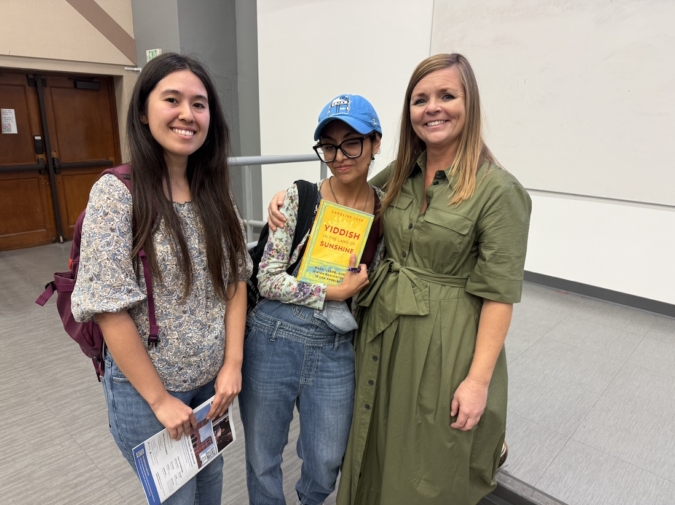
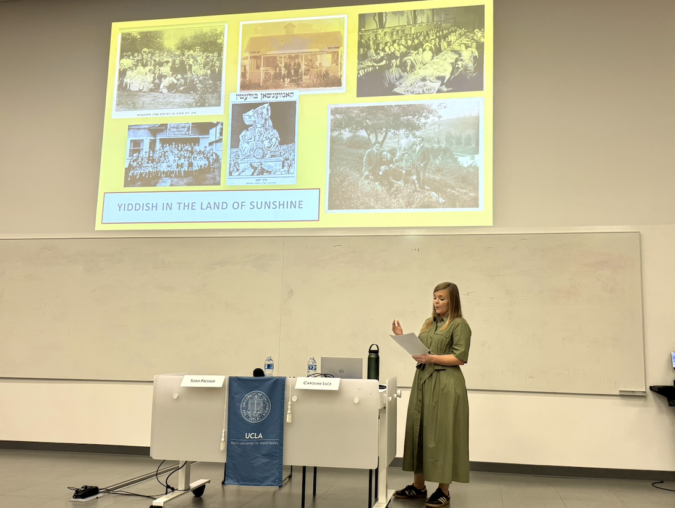
Author Caroline Luce presented her book at a special event on UCLA campus
Willa Needham | November 18
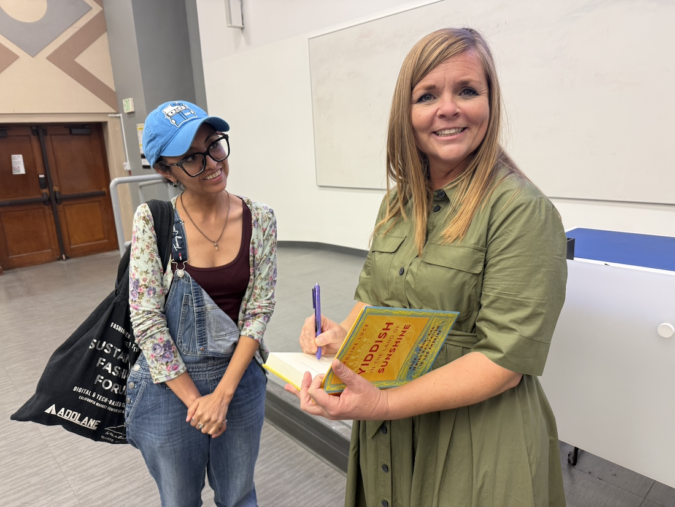
On Tuesday, November 10, students, community members, faculty and staff gathered on UCLA campus to celebrate the book Yiddish in the Land of Sunshine: Race, Labor, and Jewish Radicalism in Los Angeles, written by Caroline Luce, project director at the UCLA IRLE. The event was co-sponsored by the UCLA Institute for Research on Labor and Employment (IRLE) and UCLA Department of History and presented by the UCLA Center for Jewish Studies.
Yiddish in the Land of Sunshine tells the story of a group of radical Jewish activists born in the Russian Empire at the turn of the 20th century who settled in Los Angeles by the 1930s. Luce focuses on three key figures to create a collective biography revealing the complexities of Jewish experience and aspiration as Los Angeles developed into an urban metropolis.
Luce sets her narrative in the heterogeneous neighborhood of Boyle Heights, reframed not merely as a landing place for immigrants shut out of other areas by restrictive zoning covenants, but as a desirable and convenient area where working people could afford to own homes and achieve a version of the Western American Dream. But, as Luce points out, racial hierarchies existed within Boyle Heights, as in the rest of the city.
Rather than shying away from the difficult subjects of privilege and discrimination, Luce highlights how Jewish immigrants benefited from the dispossession of indigenous land and the hierarchical dual-labor system in Los Angeles, while also being racialized and targeted themselves.
Luce argues that Yiddish served as a secular “mode of belonging” that, while at first insular, eventually gave way to multiracial solidarity. The rise of fascism and nazism in the 1930s awakened young radical activists to the fact that their experiences of antisemitism were intertwined with police brutality, redlining and the mass deportation of Mexican and Asian immigrant workers.
Radical Jewish activists recognized that combating antisemitism and other forms of repression and discrimination was impossible in isolation and required united, organized action alongside other marginalized communities in Los Angeles. Antifascism became a powerful mechanism to embrace an enduring, transformative notion of solidarity and build multiracial labor and political coalitions.
In the closing Q&A, Luce said she hopes the next generation takes inspiration from the activists who came before them. To the students in the audience, Luce highlighted that many of the radicals she wrote about were only 20 or 22 when they started engaging in social change movements.
“You don’t have to wait for permission,” Luce said. She concluded by saying she hopes her book leaves readers with “a sense of radical possibility and potential” as we confront complex modern challenges.
The UCLA Institute for Research on Labor and Employment (IRLE) advances labor research and education for workplace justice. Through the work of its units and initiatives, the Institute promotes effective public policy, bridges campus and community, and prepares the next generation of scholars and organizers. This year, the IRLE is proud to celebrate its 80th anniversary.