“Generation Union”: The people and strategies powering the labor movement in the 2020s
Sociologist and former IRLE Director Ruth Milkman returned to UCLA campus to give a lecture on labor organizing trends and union growth prospects
Willa Needham | February 6, 2026
The U.S. labor movement made gains in the 2020s, with headline-grabbing union elections, massive strikes and public approval nearing an all time high. But according to top labor sociologist Ruth Milkman, recent wins might not be enough to reverse the broader trend of decline.
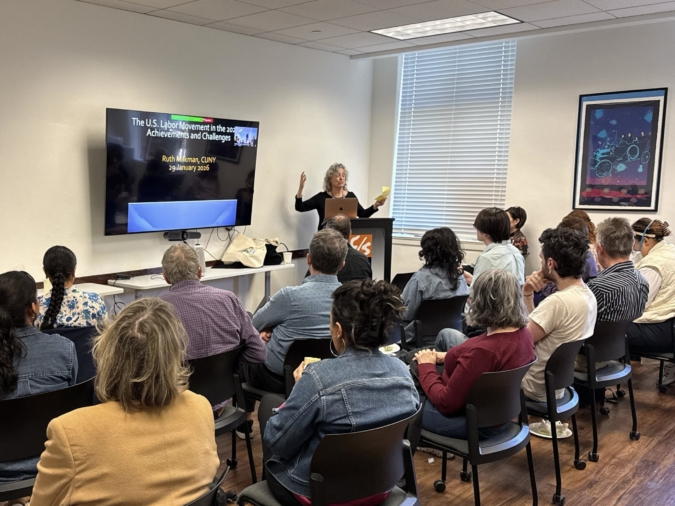
“These [waves of organizing] come and go, and this one might go, too… but I’ve learned the hard way that you can’t predict the future very well,” she said to a room filled with UCLA students, faculty and staff.
Milkman joined the UCLA Department of Labor Studies last week as part of its Labor Studies Now speaker series to discuss the achievements and challenges of the labor movement in this pivotal decade. Milkman’s campus talk was a homecoming for the scholar, who previously taught at UCLA for 21 years as a professor of sociology and served as Director of the Institute for Research on Labor and Employment (IRLE) from 2001 to 2007. She is currently a professor at the CUNY School of Labor and Urban Studies, where she chairs the Department of Labor Studies
Milkman argued that the upsurge of strikes and organizing drives is significant, yet concentrated in few sectors and limited by structural forces. The increase of labor activity was catalyzed by the pandemic, which amplified the visibility of labor issues and temporarily created a tight labor market. A new generation of leaders began organizing under these conditions, motivated by economic challenges and their strongly developed sense of class consciousness.
Milkman called the young millennial and Gen Z organizers “Generation Union,” borrowing a term coined by labor journalist Harold Meyerson. Milkman said the protagonist of this group of leaders is the “graduate with no future,” highly educated young people who struggle to find suitable employment.
As a result of their education, some young organizers have what Milkman calls “class confidence,” which she says is “the sense that you’re not gonna be cowed by some idiotic manager at Starbucks into not organizing, because you know that you can do it.”
But not all union campaigns are created equally. Milkman used the power resources model to illustrate why certain workers can make gains against their employers more effectively than others.
Young people excel at shaping public narratives using social media to win broad support, as demonstrated by workers at Amazon and Starbucks, yet their campaigns have often fallen short of what they need most: a better contract. Meanwhile, workers who have more leverage against their employers, like harder to replace highly educated professionals, have been more successful in securing substantive changes to their working conditions.
Whether the 2020s marks a new resurgence of the labor movement or a temporary blip remains an open question. Milkman highlighted similarities between the current moment and the early 1930s, when many erroneously dismissed unions as a declining force. “Maybe we’ll get lucky again,” she remarked.
One prediction she could state with confidence is that the new generation of leaders is “not going anywhere.” Despite having the odds stacked against them, contending with massive corporate power and outdated regulatory systems, the next generation will continue organizing towards their vision of a more accepting, intersectional and equal future.
The UCLA Department of Labor Studies is the first department of its kind at the University of California. Since its founding in the early 2000s, the academic program has been renowned for its commitment to engaged student learning in community worker settings, rigorous hands-on research and courses that explore urgent labor and social justice issues.