
UCLA Labor Studies alum centers refugee narratives in powerful documentary
Jennifer Cárcamo presented her film “Eternos Indocumentados” in a labor studies class and answered students’ questions
Tanveer Sandal and Willa Needham | December 11, 2025
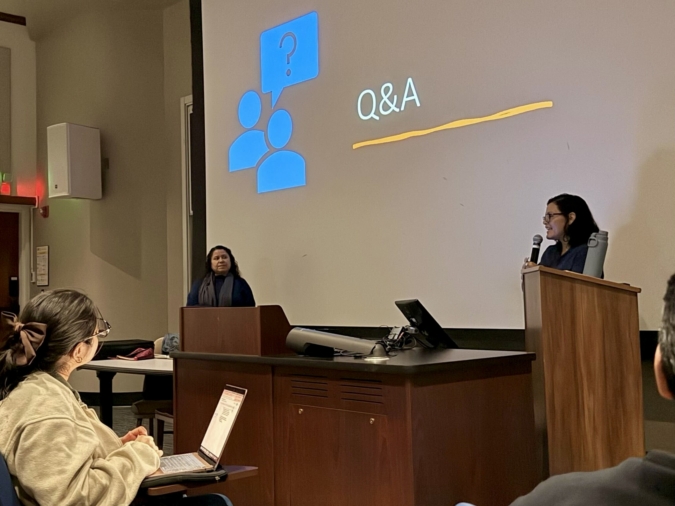
Students, faculty and UCLA community members gathered at Dodd Hall on November 5 for a presentation of the documentary film “Eternos Indocumentados.” The director of the film, Jennifer Cárcamo, joined UCLA Labor Studies Professor Leisy Abrego for a Q&A moderated by Jennifer Chun, interim Chair of the Labor Studies Department.
“Eternos Indocumentados” follows the stories of Central American refugees to explore the root causes of forced migration. The film is centered on the testimonies of refugees as they recount their experiences of migration, work and in some cases, detention and deportation. In her narrative, Cárcamo highlights the role of neoliberalism, imperialization and militarization in contributing to the global refugee crisis.
Cárcamo is an independent filmmaker and scholar whose research focuses on the Salvadoran and Central American diaspora. She was born in Los Angeles to a Salvadoran family that sought refuge from the civil war. Her desire to understand her family’s migratory history largely shaped the direction of her educational interests and future projects.
As an undergraduate at UCLA majoring in political science and minoring in labor studies, Cárcamo was deeply involved in student organizing. She stayed engaged as she pursued her masters in documentary and film studies at Syracuse University and her Ph.D. in history at UCLA. Her activism and education inspired her in-depth study of the Central American refugee community in “Eternos Indocumentados.”
In conversation with Professor Abrego, Cárcamo discussed the political context of her film and how the subject matter has been reflective of the contemporary political climate in the United States. Filming for “Eternos Indocumentados” began in 2014 during President Obama’s first term, when activists organized in response to the federal mass deportation agenda and the expanded practice of family detention.
Cárcamo emphasized that the anti-immigration sentiment that intensified during President Trump’s first and second terms has historical precedent. “The film helps us realize it’s not new,” she said, referring to the federal government’s current deportation agenda and anti-immigrant rhetoric.
During the Q&A, Cárcamo shared that she is motivated to shift the refugee narrative through her filmmaking. Popular media typically portrays refugee individuals and communities as victims, but as Cárcamo highlights in the film, refugees often exercise personal and political agency. Cárcamo said the subjects of the film were “very actively trying to organize for their freedom and for their liberation, from these detention centers and also within the U.S. after their release.”
According to Cárcamo, “Eternos Indocumentados” is “for, by and about Central Americans.” Her approach as a filmmaker is rooted in her identity and community, as she strives to approach her subjects and audience as co-collaborators. Prior to the screening at UCLA, the film was primarily shown in community and worker-oriented spaces, like the Central American Research Center.
Students in the audience expressed that they felt engaged and energized after viewing the film. One student shared: “The film was very inspiring and it’s made me think a lot about migration. I’m an immigrant myself, but I’m from South America.” The Q&A and screening created a participatory space that acknowledged refugees and migrants’ struggles while also honoring their powerful legacies of resistance.
To learn more about Jennifer Cárcamo, read her UCLA Labor Studies alumni Q&A here. “Eternos Indocumentados” can be streamed for free on Vimeo. Stay tuned for more events from the UCLA Department of Labor Studies’ “Labor Studies Now” series in the coming year.
The UCLA Department of Labor Studies is the first department of its kind at the University of California. Since its founding in the early 2000s, the academic program has been renowned for its commitment to engaged student learning in community worker settings, rigorous hands-on research and courses that explore urgent labor and social justice issues.

 Photo courtesy of Jennifer A. Cárcamo.
 The LOSH team and partners from LA County Department of Public Health’s Office of Worker Health and Safety conduct outreach to workers cleaning up toxic ash and debris after the 2025 fire in Altadena. / UCLA LOSH