
LOSH supports workers in the aftermath of the 2025 Los Angeles fires
The Labor Occupational Safety and Health (LOSH) Program leads education and research efforts for workers in the Pacific Palisades and Altadena
UCLA LOSH | January 26, 2026
One year ago, a devastating series of wildfires swept through the greater Los Angeles area, leaving lasting destruction in their wake. At least 30 lives were lost while 16,000 structures were destroyed and 150,000 people displaced. In response to this crisis, the Labor Occupational Safety and Health (LOSH) Program, a unit of the Institute for Research on Labor and Employment (IRLE), has dedicated significant resources over the past year to support the safety and wellbeing of workers involved in cleanup, recovery and rebuilding.
“The LA Fires represented one of the most serious worker health challenges our region has ever confronted,” said Kevin Riley, LOSH Director. Hundreds of workers were mobilized for cleanup and recovery efforts, putting them at risk of exposure to toxic ash and debris. The pressures from property owners and officials for a speedy cleanup only heightened the health and safety risks for frontline recovery workers.”
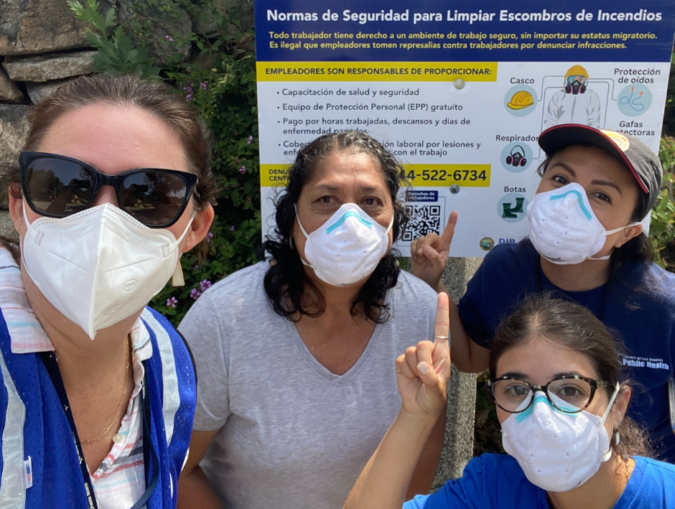
LOSH’s outreach and education efforts have focused on reaching workers in the hardest-hit communities of Pacific Palisades and Altadena. Through collaborative and longstanding partnerships with the Instituto de Educación Popular del Sur de California (IDEPSCA), National Day Laborer Organizing Network (NDLON), Southern California Coalition for Occupational Safety and Health (SoCalCOSH), and the LA County Department of Public Health’s Office of Worker Health and Safety (OWHS), LOSH developed educational materials in both English and Spanish highlighting the dangers of fire cleanup, especially the risks posed by toxic ash and dust, and emphasizing the importance of respiratory protection to safeguard workers’ health.
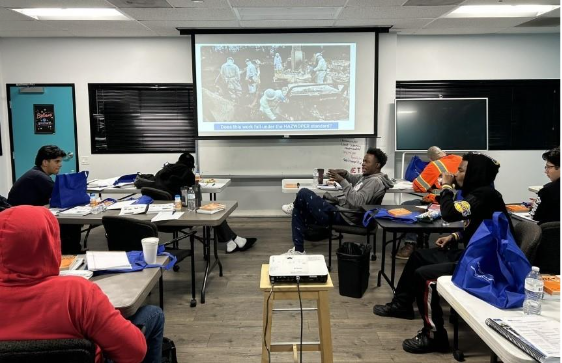
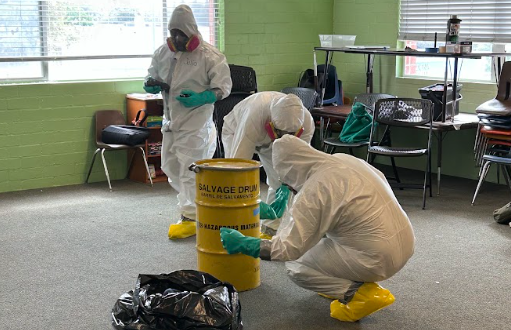
To further support worker safety during recovery from the fires, LOSH expanded its 40-hour HAZWOPER course offerings to extend training and certification for workers engaged in cleanup and remediation. These courses are crucial for workers assigned to remove hazardous materials and contaminants from impacted properties, allowing owners to begin the next steps of rebuilding. The HAZWOPER training initiatives are funded by the NIEHS Worker Training Program, which recently released this video highlighting the role of WTP grantees in offering just-in-time training to disaster workers across the country.
Meanwhile, LOSH’s research team has been actively documenting the experiences of day laborers and domestic workers involved in the recovery efforts. In partnership with IDEPSCA and NDLON, they surveyed over 150 workers hired for fire–related jobs in the affected communities. LOSH’s collaborators in the UCLA Fielding School of Public Health conducted environmental sampling and personal monitoring to better understand the risks these workers face during cleanup, while project partners at California State University Long Beach have documented the role that worker hiring sites have played in providing education and support to this informal disaster workforce. These activities are funded by the UC California Climate Action Initiative, and the results of these various research activities will be disseminated in the coming months.
As efforts in the Palisades and Altadena shift from cleanup to reconstruction, LOSH is poised to continue these collaborations to confront the next phase of health and safety challenges, particularly those related to residential construction work. “The restoration of Altadena and the Palisades is a long road,” said Dr. Riley, “and we remain committed to supporting the safety and wellbeing of workers engaged in those efforts every step of the way.”
The Labor Occupational Safety and Health (LOSH) Program is an outreach and engagement program whose mission is to promote safe jobs, healthy lives, dignity and a voice for all. LOSH’s worker education and research initiatives are designed to engage workers across industries and sectors in Southern California, with a particular focus on those in high-risk worksites and those who are underserved.