
“That’s why we persist”: Hollywood Diversity Report celebrated at UCLA TFT panel
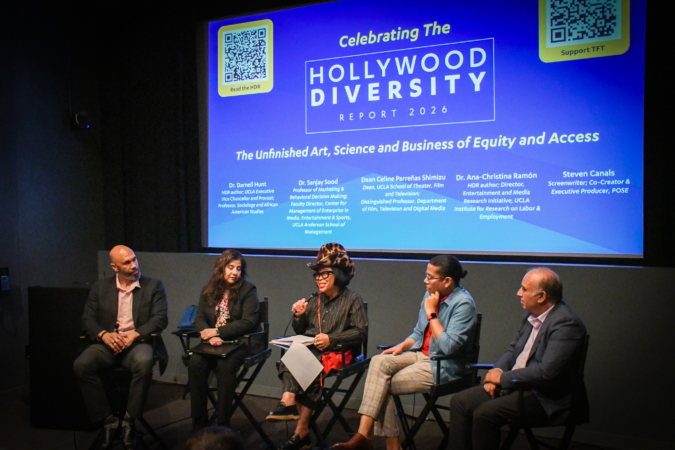
Last week, the UCLA School of Theater, Film and Television (TFT) hosted a panel spotlighting the Hollywood Diversity Report, featuring co-founders of the report, experts and creator of the television series Pose.
Willa Needham | April 21, 2026
“Oh, there’s the confirmation that this story is necessary, that it is needed,” thought Steven Canals, UCLA TFT MFA ‘15 alumnus and award-winning screenwriter and producer, after reading the first edition of the Hollywood Diversity Report in 2013.
A master’s student in the UCLA School of Theater, Film and Television (TFT) at the time, Canals had just finished a draft of what would become the acclaimed television series Pose, which broke barriers, featuring the largest cast of transgender actors in television history.
The Hollywood Diversity Report, tracking the diversity metrics of top films and television series, validated Canals’ sense that popular media did not sufficiently represent his communities. Now in its 13th year, the Hollywood Diversity Report provides a wealth of longitudinal evidence of Hollywood’s failure to proportionally represent people of color, women, LGBTQ+ people and people with disabilities in its most viewed films and television series, both on screen and behind the scenes.
Last week, UCLA TFT hosted a panel titled “Celebrating the Hollywood Diversity Report 2026: The Unfinished Art, Science and Business of Equity and Access,” featuring report authors, Ana-Christina Ramón and Executive Vice Chancellor and Provost Darnell Hunt, Professor Sanjay Sood and Canals, writer, co-creator and executive producer of Pose. The panel was introduced and moderated by Dean Celine Parreñas Shimizu as part of TFT’s Ripples of the L.A. Rebellion programming initiative.
Speaking to an audience of students, academics and entertainment industry workers at the panel, Canals continued: “Whenever I see the Hollywood Diversity Report, I always look at it and I think, ‘That’s why we persist. That’s why we keep moving. That’s why we keep centering the lives that we center in our narratives.’”
“Whenever I see the Hollywood Diversity Report, I always look at it and I think, ‘That’s why we persist. That’s why we keep moving. That’s why we keep centering the lives that we center in our narratives.’”
– Steven Canals, writer, co-creator and executive producer of Pose
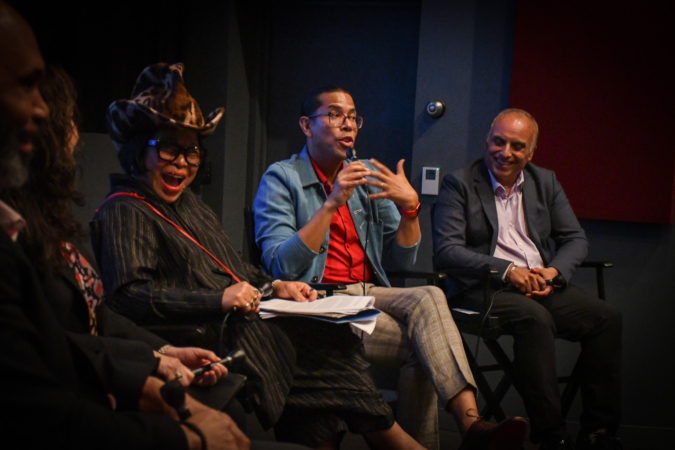
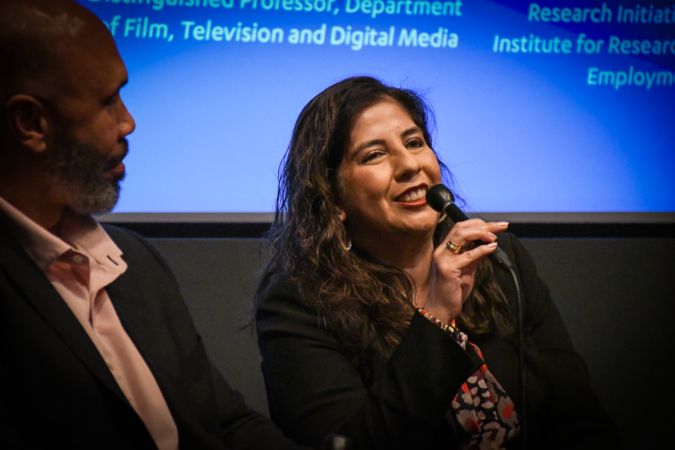
Beyond providing inspiration to aspiring and acclaimed storytellers alike, the Hollywood Diversity Report offers a compelling economic argument for inclusivity that should perk the ears of top executives: diverse films and television series consistently draw in high earnings among popular audiences, which are increasingly diverse.
“Diversity sells at the box office,” said Ramón, co-creator of the report series and founding Director of the Entertainment and Media Research Initiative (EMRI) at the UCLA Institute for Research on Labor and Employment (IRLE). “Films with more diverse casts keep winning.”
Ramón noted the most recent report revealed that films with diverse casts topped almost every metric of success, including median box office earnings and rank. In addition, the report showed that moviegoers of color bought the majority of opening weekend tickets for more than half of the top 20 films of 2025.
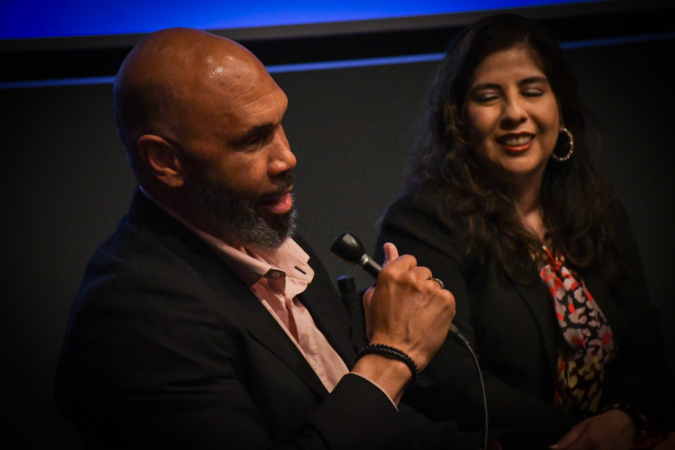
Hunt, who co-founded the report with Ramón, recalled specifically designing the report to demonstrate the relationship between diversity and economic outlook in Hollywood. Hunt summarized the feedback he and Ramón received from studio heads as they assessed the goals of the report: “If you can tie [diversity] to the bottom line and show them that it’s about money you’re leaving on the table, then maybe people would take notice.”
With nearly 30 installments in 13 years, the Hollywood Diversity Report has continuously demonstrated that diversity delivers economic success, yet representation in popular film and television lags behind. Investing in diversity is still considered risky by the executives who hold the money.
“What a profound economic and moral contradiction: the audience is diverse, the profits flow from diverse audiences, yet the creative power remains concentrated,” said Sood, who teaches marketing and behavioral decision making at the UCLA Anderson School of Management.
“Studios are still run largely by a group of people that do not look like the audience…That’s how the system reinforces itself,” he said.
“What a profound economic and moral contradiction: the audience is diverse, the profits flow from diverse audiences, yet the creative power remains concentrated.”
– Sanjay Sood, UCLA Anderson School of Management.
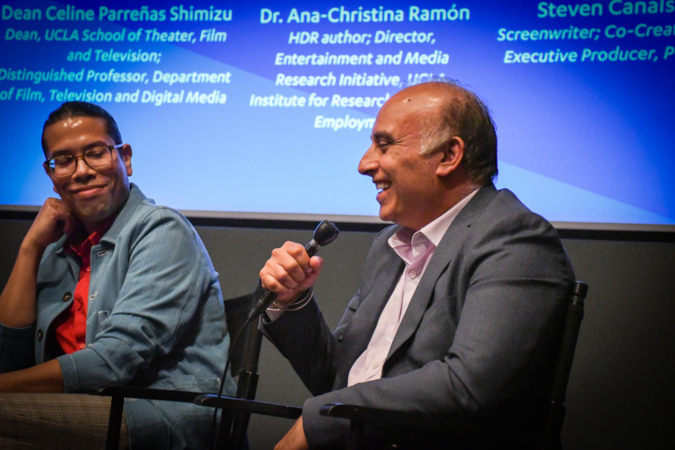
Dean Shimizu, who moderated the event, emphasized the importance of reliable, university-supported research to demonstrate the need for change: “The Hollywood Diversity Report is a roadmap that clarifies where the work [of inclusivity] can deepen and expand and how fully the conditions of cinema are evolving,” she said.
In her introduction, Shimizu situated this evolution as part of an ongoing process within the historical context of the L.A. Rebellion, a film social movement driven by UCLA students in the late 1960s, which created space for Black, multiracial and global voices in the Hollywood film industry through protest and subversive film techniques. Ten films created by UCLA student filmmakers during the L.A. Rebellion were later inducted into the National Registry of the Library of Congress for shaping American cinema.
Ramón shared that younger generations continue to give her hope as changemakers in the industry: “If Hollywood is not willing to change, then these kids [Gen Z and Gen Alpha]… they’re going to make their own system,” she said. “Kids under 18 are majority BIPOC, so change is already here in terms of the population.”
To close the panel, Canals encouraged students and creatives in the audience to remain unapologetic and “turn the volume up” on their authentic voices, believing that the persistence of storytellers and artists is what will continue to push the industry forward, and bring culture with it.
The Entertainment and Media Research Initiative (EMRI) at the UCLA Institute for Research and Labor and Employment (IRLE) explores equity and access issues affecting entertainment industry workers and tracks the viewing habits of increasingly diverse audiences.

 Aaron Brenner (UFCW)