
“Hope is something we make”: Solidarity and care in the South Korean labor movement
UCLA Labor Studies chair Jennifer Jihye Chun and Ju Hui Judy Han presented their book Against Abandonment: Repertoires of Solidarity in South Korean Protest
Willa Needham | May 26, 2026
Imagine climbing to the top of an industrial crane more than 100 feet above the ground to live in isolation for an indefinite period, without electricity or running water, while battling extreme weather conditions. You might be wondering what would push a person to take such perilous action.
For South Korean workers and union activists engaging in kogong nongsŏng, or high-altitude occupation, that question is not hypothetical. Camping out on landmarks towering above towns and cities for months and sometimes years is but one strategy in a repertoire of high-stakes public protest actions performed to demand recognition and improve work conditions.
Such protests are often led by women workers and those in precarious or irregular industries fighting job loss and persistent workplace discrimination. But high-altitude occupations, and other physically and mentally taxing protest tactics, are more than a means to achieve stated demands.
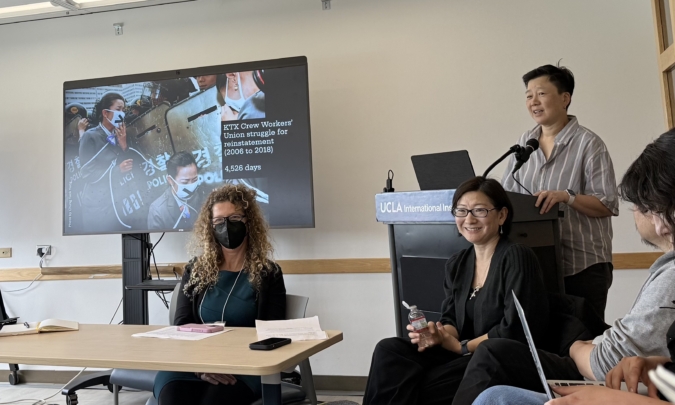
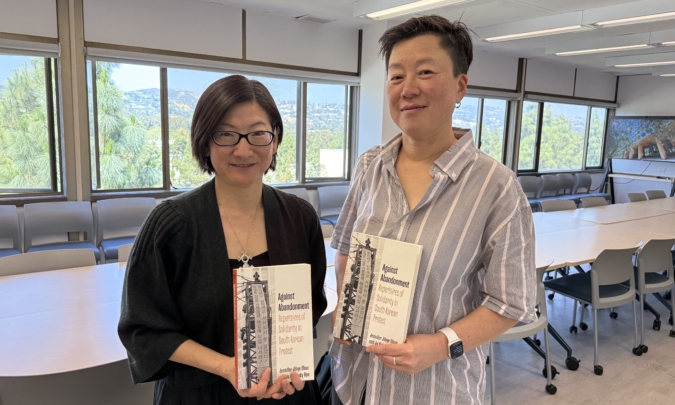
On Thursday, May 14, UCLA students, faculty, staff and community members filled a room on UCLA campus to celebrate the release of the book Against Abandonment: Repertoires of Solidarity in South Korean Protest. The authors, Ju Hui Judy Han, associate professor of gender studies at UCLA and Jennifer Jihye Chun, professor of Asian American studies and chair of the UCLA Department of Labor Studies, presented their book as part of the Labor Studies NOW series.
Chun and Han elaborated on the main ideas of the text and dispelled misconceptions about high-stakes actions in the Korean protest repertoire, including hunger strikes, occupations and long-term encampments.
“I hear over and over again these types of protests are just about getting public sympathy, as a means to an end, that it’s just for public attention,” Chun said. “The intervention we really want to make is that these repertoires are not just about achieving utilitarian goals. It’s about doing, witnessing and supporting life or death protests as practices of solidarity.”
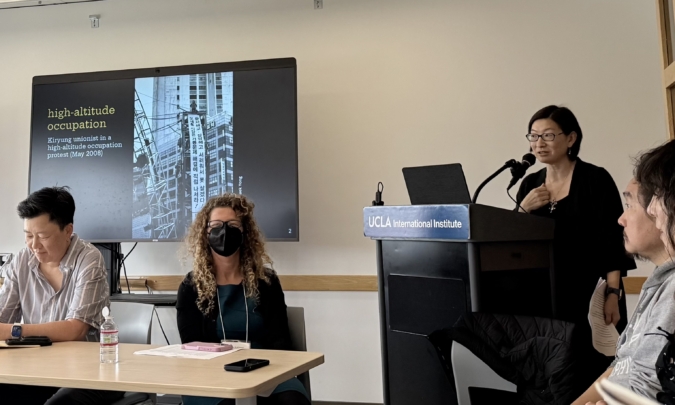
Tobias Higbie, director of the UCLA Institute for Research on Labor and Employment (IRLE), moderated an engaging panel that invited the authors and guest scholars, Jong Bum Kwon, associate professor of cultural anthropology at Webster University; Zeynep Korkman, associate professor of gender studies at UCLA; and Hannah Appel, associate professor of anthropology and global studies at UCLA, to expand on the themes of the text and connect them to contemporary protest movements in Los Angeles.
Han and Chun presented key case studies from their book, complete with arresting visuals of grueling protest rituals performed by Korean workers in their struggles for justice. In one photograph, workers lay on the pavement flat on their stomachs, making contact with five points of their body. Activists stand, step forward and repeatedly get on the floor in the painstaking ritual of och’et’uji. In another photograph, a KTX train worker applies a sheet face mask as part of her regular skincare routine after spending hours protesting outdoors on a hot summer day while participating in a three-year encampment at Seoul Train Station.
Han pointed out that within prolonged, intense campaigns, there is still room for fun and social connection. In fact, high-stakes protest actions necessarily generate community, care and networks of mutual aid between the protesters, other activists and the public. An encampment, for example, can be sustained only if allies provide food and water and participants emotionally and physically care for each other.
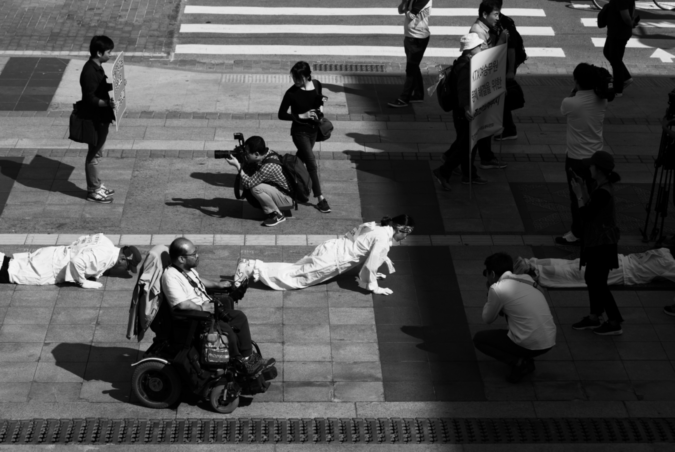
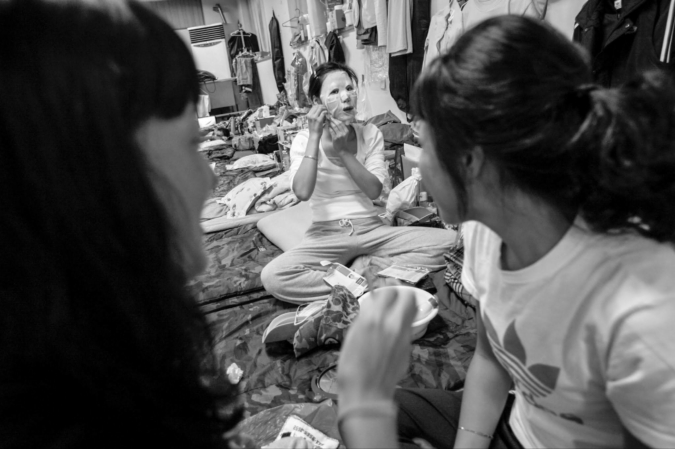
Sometimes, Han and Chun noted, the systems of solidarity and care that emerge from protests are the most tangible outcomes of the actions.
Social change can be difficult to measure, often because it only becomes legible cumulatively over time, across decades of continual effort. During her analysis, Appel highlighted that acknowledging the social outcomes of protests as valuable achievements has the potential to prevent discouragement and burnout so common among activists.
In their discussion of long-term change, each of the panelists returned to the same theme: hope. Kwon recalled feeling despair while conducting research with laid-off South Korean auto-workers who had lost everything, unable to imagine a positive outcome. Kwon shared:
“With some embarrassment, I must admit, it was one of the workers who comforted me, stating, ‘Hope is something we make.’”
Social movements can only be sustained through the ongoing process of care and solidarity. Korkman, too, commented on the necessity of hope and community, thanking Chun and Han for their “non-naive” vision of hope, rooted in practices of solidarity rather than in an imagined future where those in power make concessions readily. To a room filled with students, activists, educators and socially-engaged community members, the resounding message of Against Abandonment served as an inspiring and refreshing perspective shift.
The UCLA Department of Labor Studies is the first department of its kind at the University of California. Since its founding in the early 2000s, the academic program has been renowned for its commitment to engaged student learning in community worker settings, rigorous hands-on research and courses that explore urgent labor and social justice issues.

 Students, faculty and staff participating in the UCLA Labor Studies 2026 May Day contingent pose for a group photo outside of the UCLA James Lawson Jr. Worker Justice Center in MacArthur Park / UCLA Labor Studies
 Student presenters and participants gather for a group photo during the 2026 Labor@UCLA Research Showcase / UCLA Labor Studies