
Fourth Annual Labor@UCLA Research Showcase: Student Research Projects in Labor Studies
See what Labor Studies students researched this year at the fourth annual Labor@UCLA Research Showcase
Marcos Ruiz Rojas | June 5, 2026
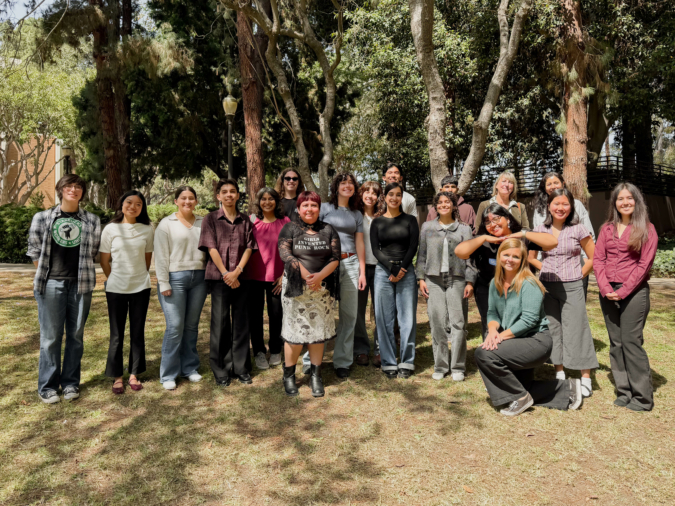
The Labor@UCLA Research Showcase returned for its fourth annual installment on May 22, featuring UCLA Labor Studies undergraduates and their original research on work, labor, and economic justice. Student projects spanned a broad range of topics, from Motivations and Strategies Amongst Unionizing Rideshare Drivers to A Labor Justice Approach to Reinventing Government Enforcement in Los Angeles County.
This year’s showcase was part of UCLA’s Research Week, a university-wide celebration of undergraduate research and creative inquiry held May 18–22.
UCLA Labor Studies is an interdisciplinary field of study and public engagement that examines work, working-class communities, and the political economy of labor as intersectional and multi-dimensional sites of inquiry. The department seeks to understand how inequality operates in the world of work and to identify effective strategies for addressing it and building healthy, democratic communities.
Browse this year’s student research abstracts below.
Cris Avitia Camacho ‘26, Labor Studies major
Research Title: Farmworkers Feed Us: Lack of Access to Healthcare and (Dis)ability
This research project examines the barriers that shape Latinx farmworkers’ access to healthcare and how those barriers increase the risk of long-term work-induced disability. Drawing on a Spanish-language survey distributed at a health fair in Oxnard, California, this project identifies financial instability, insurance costs, and the lack of culturally sensitive care as major obstacles preventing farmworkers from seeking medical attention. Survey participants also expressed fear that workplace injuries could limit their ability to continue working in the fields, revealing how health concerns are deeply tied to economic survival.
These survey findings are paired with an interview from a farmworker family member who described the long-term effects of agricultural labor on multiple relatives, including disabilities connected to chemical exposure, physically demanding labor, and harsh working conditions. Together, these methods offer a preliminary understanding of how disability is recognized, experienced, and often normalized within Latinx farmworking communities.
Hana Chekol ‘26, Political Science and Sociology double major
Research Title: How School Facilities and Parks Can Affect Community and Student Experiences
This study was developed in Labor Studies M136, Working Families and Educational Inequalities in Urban Schools. It uses Brentwood Science Magnet Elementary School as a case study to evaluate the impact of joint-use school facilities and affluent school neighborhoods on community engagement and student learning. In Los Angeles, low-income neighborhoods do not have equal access to safe outdoor spaces. This research explores how opening up school facilities to the public can help fill the recreational needs of communities that otherwise lack access to them. Instead of lying vacant outside of school hours, school grounds can serve as vital resources to the neighborhoods that they inhabit. The research used a qualitative ethnographic design consisting of three separate site visits involving non-participant and unobtrusive observations.
Cecilia Choy ‘27, Labor Studies major; Elena Fuentes ‘26, Labor Studies minor; Natalia Soria Haro ‘26, Labor Studies major; Saul Murillo Alvarez ‘26, Labor Studies major
Research Title: Student Labor, Student Lives: The Hidden Layers of Student Worker Struggles
The UCLA Labor Studies Research Program (LSRP) explores the experiences and challenges of undergraduate student workers in Los Angeles County. Between July and August 2025, 30 student researchers conducted 154 surveys and 30 interviews, with additional interviews being collected in May 2026.
The surveys captured broad trends across different student worker experiences, while the interviews provided deeper insight into individual experiences. Our study participants encompass different gender identities, ethnicities, ages, and backgrounds coming into college, including a fifth of the respondents enrolled in community college during their last term. This study examines four key areas: work and school balance, finances and living expenses, working conditions and organizing, and federal policy impacts on student workers.
Findings indicate that a majority of respondents are full-time students and work between 10 and 29 hours per week. Many are facing high levels of stress balancing work and school, have limited awareness or access to workers’ rights and organizing resources, and concerns about federal impacts on financial aid access.
We recommend promoting education within the institution and among professors to expand synchronous and asynchronous options for student classes, increasing student awareness of legal rights and resources available to them, amongst other efforts to implement internship and capstone requirements in majors in line with the student worker experience.
Mason Ng ‘26, Labor Studies minor
Research Title: Organizing Against the Algorithm: Motivations and Strategies Amongst Unionizing Rideshare Drivers in Los Angeles
Rideshare driving, one of the first and most popular app-based services in the platform economy, is traditionally hailed for its innovative work model and the flexibility it provides its workers. However, in recent years, rideshare drivers have suffered multiple workplace abuses, including employee misclassification, unfair app deactivations, and wage manipulation dictated by a black box algorithm. In urban spaces like Los Angeles, labor organizing in the form of rideshare unions such as Rideshare Drivers United (RDU) seeks to resist, remedy, and prevent these abuses through collective action, raising the quality of rideshare driving for all workers.
Drawing on interviews with 12 RDU members and ethnographic field notes from union meetings, recruitment sessions, and public actions, this study explores why rideshare drivers participate in labor organizing, what strategies they engage in to do so, and their perceptions of RDU and trade unionism. I argue RDU members are differentially predisposed to union joining by their previous experience with labor organizing and desire to participate in community building. RDU members also place great importance on experience as a rideshare driver as a prerequisite for organizing in a rideshare union, differentiating their organization from large, bureaucratic unions of which they are skeptical.
Skye O. ‘28, Labor Studies major
Research Title: The Angels Have No Homes Here: The History of Public Housing (and the Lack Thereof) in Los Angeles
Like almost every major city in the United States, Los Angeles has long suffered from a scarcity of affordable housing. But despite this, and unlike most of its counterparts in the Northeast and Midwest, Los Angeles has a longstanding lack of Section 9 public housing. To put it in perspective, New York City has 177,000 Section 9 units. Los Angeles, a city with only half the former’s population, has 6,300. This research project investigates the reasons behind the undersupply of public housing in Los Angeles and examines how the unique social and political forces at play in Los Angeles’ history blunted the development of Section 9 public housing. Using a combination of archival research, literature reviews, and ethnographic observation of surviving public housing sites, this project pinpoints three main factors behind this undersupply:
- Los Angeles’ historically strong individualist and anti-communist inclinations, which led many middle-class Angelenos to be deeply skeptical of publicly-owned housing
- The absence of a strong social reform movement capable of combating this mindset in mid-century Los Angeles
- The incongruity of the spatial concentration of poverty intrinsic to public housing with the spatial control tactics used in the LAPD’s “war on crime”
This research project will also discuss how the war on public housing is intimately related to neoliberalism’s broader war on the working class and the labor movement. In its examination of the history of L.A. public housing, the project will further look at the role the labor movement played in its creation and protection.
Karla Perez ‘26, Labor Studies major
Research Title: Reclaiming Wages, Centering Workers: A Labor Justice Approach to Reinventing Government Enforcement in Los Angeles County
Los Angeles County loses an estimated $1.4 to $2.5 billion annually to wage theft, yet its enforcement system remains fragmented, complaint-driven, and structurally inaccessible to the workers most harmed. This research examines the gaps in LA County’s wage theft enforcement process and traces the path from identified problem to policy solution, centering worker voices at every stage.
Conducted through the LA County Board of Supervisors Second District office, this project takes a worker-centered research approach, building relationships with worker centers across the county to document their lived expertise, institutional knowledge, and concrete recommendations for systemic reform. Findings from worker center interviews were brought into direct dialogue with data gathered from the Office of Labor Equity (OLE), including case breakdowns and enforcement outcomes, to map where the system falls short and where intervention is most needed.
The result is a policy framework grounded in the principle that working people are the most qualified architects to shape policy. This research traces how that framework moved from community knowledge to a formal policy proposal, how worker mobilization shaped and sustained that process in the face of opposition, and what it looks like to reinvent a government space through a labor justice lens.
Mildred Thornton ‘26, Labor Studies minor
Research Title: How Does Age and Gender Discrimination Intersect in the Entertainment Industry
My research method utilizes both interviews and qualitative coding to help bridge the gap in knowledge about how age and gender discrimination intersect in the entertainment industry. Specifically, I propose using qualitative coding to analyze interviews with older actresses to gauge the types of age and gender discrimination they experience in the workplace.
Drawing on existing literature, I identify codes that indicate age and gender discrimination, such as instances in which older actresses are pressured to undergo cosmetic procedures to appear younger in order to gain employment. This approach offers a broad understanding of how age and gender discrimination operate, while also incorporating the personal experiences of older actresses to illustrate the working conditions they face.
The UCLA Department of Labor Studies is the first department of its kind at the University of California. Since its founding in the early 2000s, the academic program has been renowned for its commitment to engaged student learning in community worker settings, rigorous hands-on research and courses that explore urgent labor and social justice issues.